
College and University Roofing in Plano, TX
Home / Property Types We Roof / College and University Roofing
Campus facilities teams tend to call us about the same pattern: a ceiling stain in a classroom or hallway that comes back after every heavy storm, under a roof that meets a taller wall, a penthouse or a stairwell bulkhead. Usually the membrane out in the field is fine. The trouble is where it turns up the wall. Base flashing pulls away, counterflashing loosens, and water gets behind it and soaks the sheathing. Once that backing is soft, new flashing has nothing to hold onto. So before we price a repair, we want to know what's behind the wall flashing, because that decides whether the job is a reflash or a reflash plus new substrate. Two bids that look alike on paper can be very different jobs if one assumes the wall is sound and the other has checked.
Collin College's Plano Campus on Spring Creek Parkway is the best-known higher-ed campus in town, and Plano Municipal Center is the city's civic anchor. We name them for orientation only and don't claim work on either. For your building, we start with the address, any drawings or past repair records your facilities office has, and the right contact for scheduling. The academic calendar and how rooms are used come from your team, not from assumptions about how campuses run.
Checking the wall flashing
During a wall flashing inspection, we follow the flashing along its full run, not just at the leak. We check seam laps at the corners, whether the top edge is sealed and mechanically fastened, the condition of the coping or counterflashing above, and whether mortar joints or wall panels higher up are letting water in behind everything. Pressing on the flashing tells us a lot: firm usually means the backing is fine, soft or hollow means it's probably wet. If we need to see inside, we'll propose a small cut, tell you exactly where and why, and patch it before we leave.
When the backing is rotted, the estimate adds new sheathing or blocking before the flashing goes back on. If studs or structural framing are damaged, the college's engineer or architect should weigh in before anything changes. We take photos before the wall gets closed up. And we don't stretch one bad spot across the whole campus. A rotted parapet on one building is a reason to check the others, not proof they share the problem.
Using moisture scans on large campus roofs
Campus roofs are often big and pieced together from different decades, so an infrared moisture survey is a sensible way to see where water has spread into the insulation. Wet areas hold heat after sunset and show up warmer on the camera. That's useful, but it has limits. The scan sees surface temperature only. It won't tell us whether the wall sheathing behind the flashing is sound, and gravel, coatings or a recent rain can skew it. We use the scan to choose where to pull cores, mark each one on the roof plan, and include patching them in the price.
We're careful about cause, too. An open seam or a rotted nailer shows what needs replacing, but not always when or why it failed. The classroom where the ceiling drips may not sit directly under the opening, because water runs along the deck before it finds a way down. So we trace it back on the roof and write down what we confirmed and what's still unknown. That way your team can see which parts of the estimate rest on what we actually opened up, and which areas still need a closer look before anyone commits money to them.
What goes into the repair
A roof repair at a campus wall usually runs in a set order: remove the failed base flashing and wet insulation at the wall, replace rotted backing, install new flashing up the wall, and finish the top with termination bar and counterflashing or new coping. How the new flashing joins the existing roof depends on the membrane. Single-ply TPO and PVC are heat-welded. EPDM uses seam tape and primer. Modified bitumen and built-up roofs need compatible plies set in hot asphalt, cold adhesive or by torch. A coating over the old flashing is a different, short-term scope. It won't fix soft backing or a loose top edge.
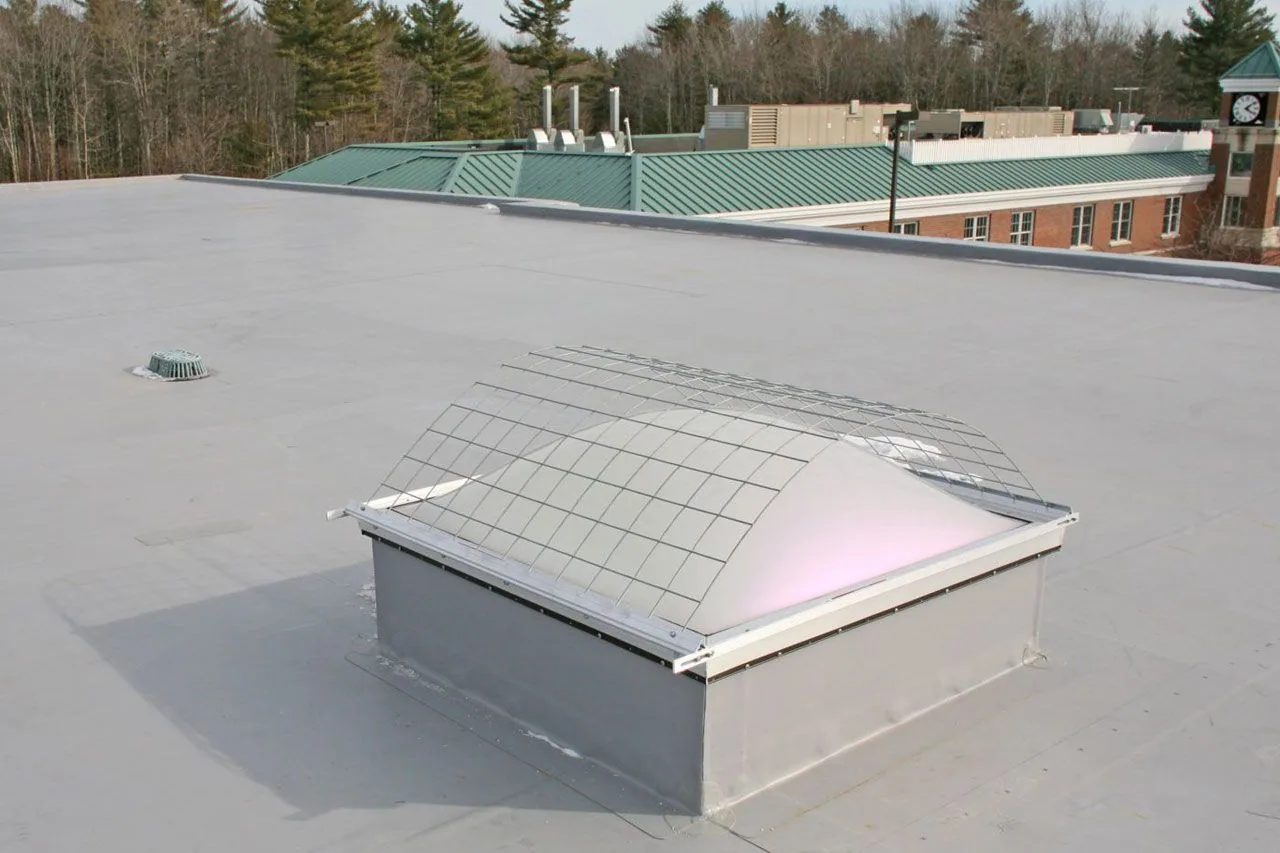
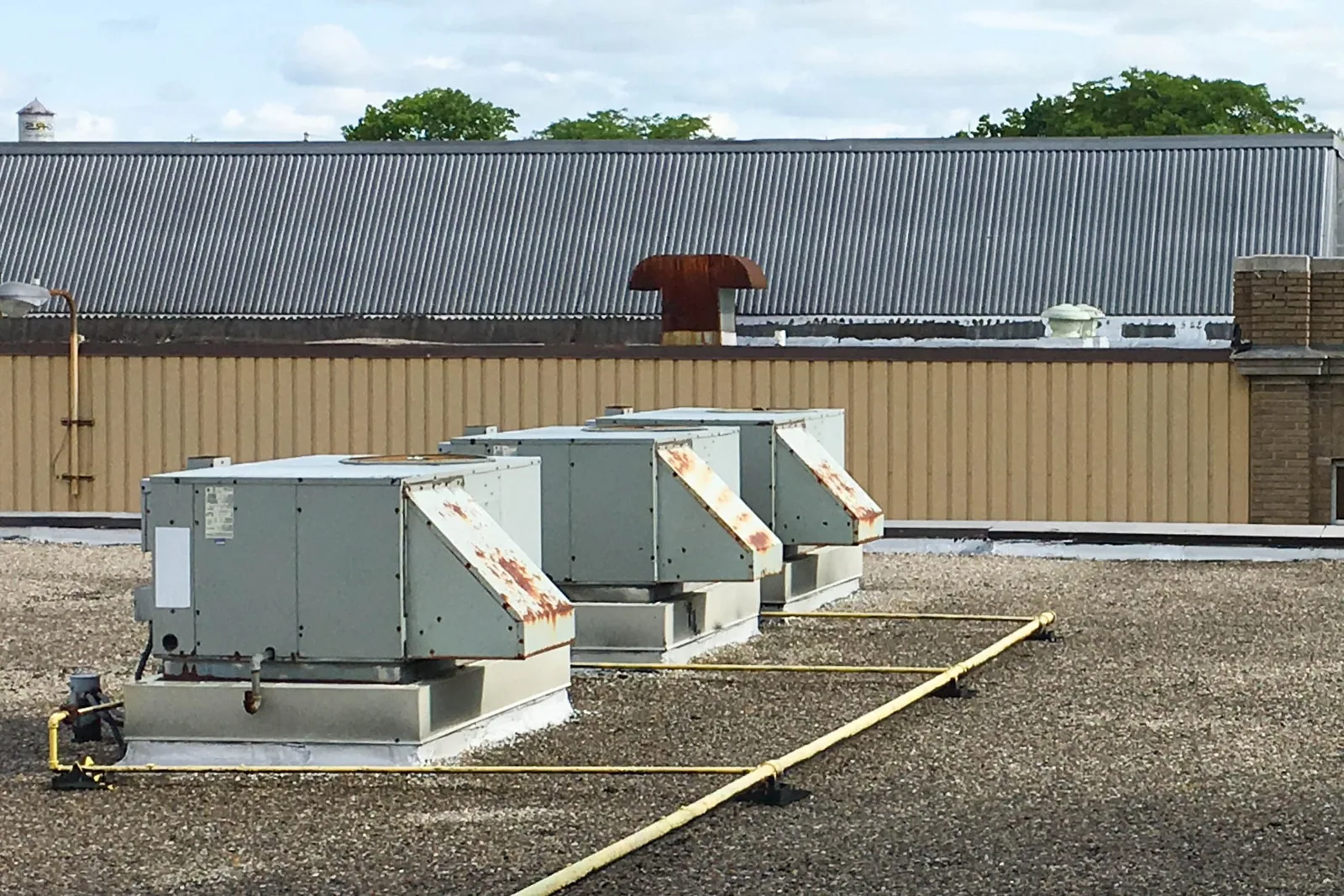
Science buildings and student centers tend to have crowded roofs. Our curb and equipment support work handles the roofing side of those penetrations, but lab exhaust fans, HVAC units and their controls belong to the mechanical contractor, who has to shut down, lift and restart them. Roof drains in the repair area get new flashing and clamp rings from us; pipe below the deck goes to the plumber. We list each trade so the scope is complete.
Planning around classes and occupied rooms
Most campus repairs happen with the building in use. For occupied-building reroofing, we sit down with facilities and go over where the roof will be open, how materials reach the roof, where the hoist or crane sets up, and what's underneath. Classrooms, labs, libraries and IT rooms each need different protection. Some need poly sheeting and drop cloths, some need equipment moved, and some need tear-off scheduled during a break or on a weekend. Facilities decides the dates and which rooms are ready. Agreeing to an inspection isn't agreeing to a tear-off, so we confirm the work plan separately, along with any rules about noise, adhesive odors and staging near walkways.
Sometimes the damage is bigger than the test cut showed. If we open the wall and the rot keeps going, we stop there, photograph it, and send a written change order: how much more tear-off, how much new backing and membrane, and whether another trade is needed. If the larger area sits over an occupied room, we recheck the protection below before going further. The roof is dried in with temporary membrane at the end of each day so nothing is left open overnight.
Closeout records for the facilities office
After the work, the facilities office should get photos of the backing before it was closed up, a roof plan showing each core and test cut and how it was patched, and a short list of what was replaced: backing, flashing, membrane, coping. Work that still belongs to another trade, such as an exhaust fan waiting on its electrician or a drain line the plumber needs to look at, is listed separately. If we couldn't reach part of a wall, the report notes where and what to check next. That record matters on campuses, where staff change and the next person needs to know what was actually done.
We cover buildings around the Spring Creek campus area and across Plano. For K-12 buildings, see our school roofing page; for administrative buildings with similar wall details, see office building roofing. Each estimate is built from what we find on your roof, not from another building's repair history or a general idea of how colleges operate.
Commercial Roofing Questions
Why does a wall flashing repair sometimes include new backing?
Flashing has to be fastened to something solid. If the sheathing or blocking behind it is wet or rotted, the fasteners won't hold and the leak comes back. Replacing that backing first is what makes the repair last.
If one wall is rotted, are the others?
Not necessarily. One bad section is a reason to check other walls, especially ones with the same exposure or detail. We price what we confirm and flag the areas that still need a look.
Can you work while classes are in session?
Often, yes. We plan tear-off zones, protection for the rooms below, and noisy or odor-producing work around the schedule your facilities team sets. Some areas may need to wait for a break or a weekend.
What if the repair turns out bigger than estimated?
We stop, photograph the added damage and send a written change order with the extra tear-off, backing and membrane. We recheck the protection below the larger area, and the roof is temporarily dried in each night.
Schedule a campus roof inspection
Have your facilities office reach out to set a time. We'll inspect the leaking wall, check the backing behind the flashing, and give you a clear repair estimate.

Request a Roof Assessment in Plano
Tell us about the building, the roof and what you are seeing. Send a request or call 555-555-5555.