Commercial Roof Repair near Medical City Plano
Home / Service Areas / Medical City Plano
The area around Medical City Plano is full of medical office buildings, outpatient clinics, imaging centers and specialty practices, along with the hospital campus itself. Roof work near patient care is different from roof work over a warehouse. Dust, odors, noise and water all matter more, and facility teams usually have written rules for contractors. We plan every repair around those rules before a crew sets foot on the roof.
We also work near the Texas Health Plano hospital district and in Allen. On medical buildings, we tell you exactly what work will happen, when and how it will be kept away from patients and sensitive areas.
Work within the facility's rules
Before scheduling, we ask the facility manager for the contractor requirements. These often cover check-in, badging, approved work hours, infection-control steps, fire-watch rules for hot work and restrictions near air intakes. On a hospital roof, the list can be long, and it is there for good reason.
We also ask which spaces sit under the repair. An operating room, an imaging suite with sensitive equipment, a pharmacy or a waiting room each needs different precautions. Some areas may need the work done at night or on weekends. Others may need ceiling protection or temporary containment below the roof while we work.
Air intakes are a big concern. Many roofing primers and adhesives have strong odors. We map intakes near the work, coordinate with facilities to shut down or filter them and choose low-odor products where possible.
All of this is settled in writing before the job starts, so the crew knows the rules and the facility knows what to expect.
Find the real source of the leak
An interior leak in a medical building gets attention fast, but the stain is rarely right under the problem. Water can run along a beam, a duct or a deck flute before it shows up. A commercial roof inspection traces it back to the source.
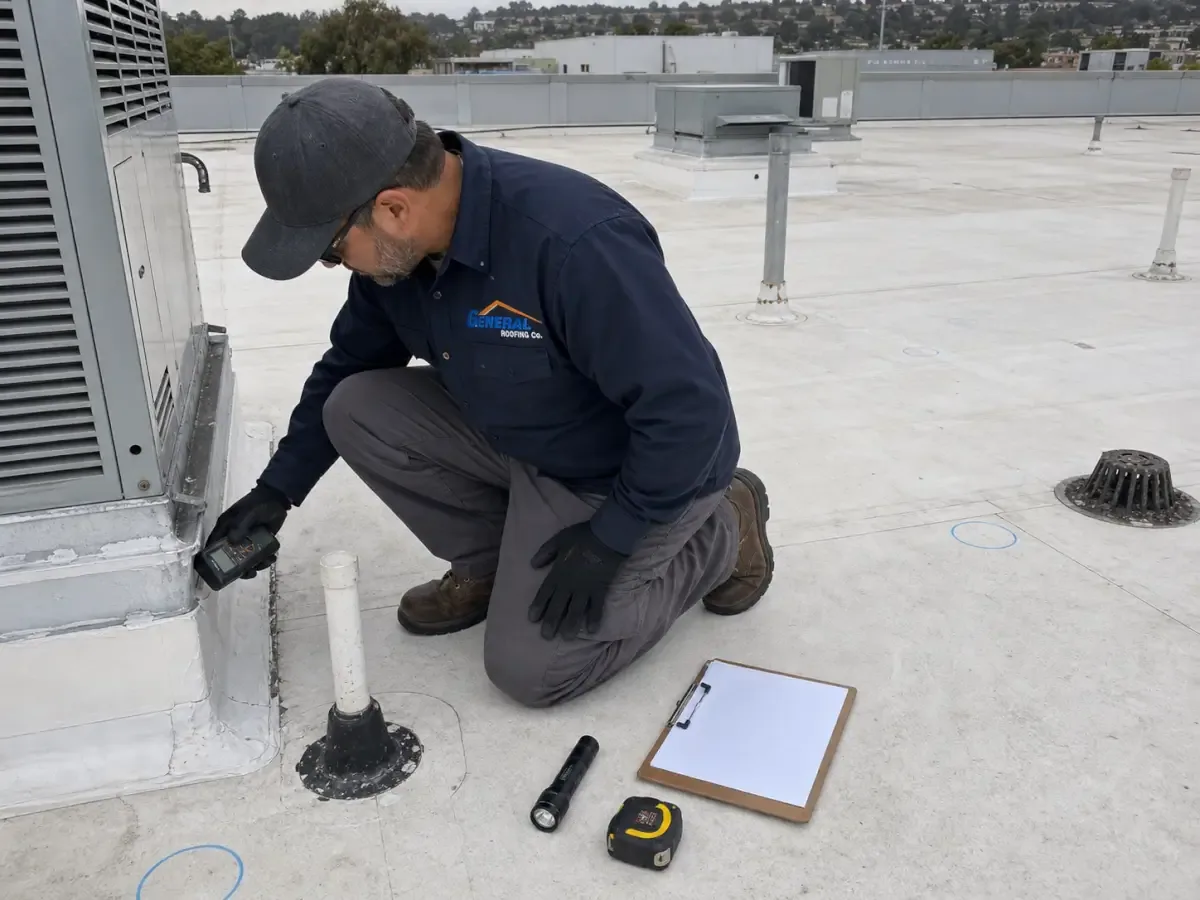
We start above the reported spot and check seams, curbs, penetrations, drains and wall flashing in the area. Medical roofs often have a lot of equipment: exhaust fans, air handlers, generator vents and medical gas lines. Each one has its own penetration and flashing, and each is a possible leak point.
Not every leak is a roof leak. Condensate lines, HVAC drain pans and cracked wall joints can all look like roof problems from below. If we trace the water to something other than the roof, we tell you so the right trade can fix it.
If the source is still uncertain after the first visit, we explain what we ruled out and what the next step should be.
Plan protection for an open roof
Not every repair can be finished in a single trip. The roof may need to be opened to dry out wet insulation, or a mechanical contractor may need to adjust a unit before we can finish the flashing. In between, the roof needs temporary protection.
With emergency roof repair on a medical building, we agree with facilities on exactly what the temporary protection covers and how long it can stay. We check the weather before each work day and only open what we can close by the end of the shift.
We also give the facility a number to call if a storm hits or a patch fails overnight. A leak over patient care cannot wait until Monday.
When the work spans several days, the crew lead updates the facility contact at the end of each shift: what was done, what is protected and what happens next.
Build a detail that lasts
On an EPDM roof, a proper repair starts with cleaning the existing rubber thoroughly and applying primer. We use compatible seam tape, cover strips and flashing, and we roll every seam to make sure it bonds fully. Sealant alone is not a repair.
Around equipment, we install proper pipe boots, curb flashing and pitch pockets as needed. If a past contractor used an incompatible product, such as an asphalt patch on EPDM, we cut it out first.
Before closing the repair, we check the insulation underneath. Wet insulation gets replaced. We photograph what we find and explain any added cost before doing the work.
We also try to understand why the detail failed. Foot traffic to rooftop equipment is a common culprit on medical buildings, where service contractors visit often. Walk pads along the service path can prevent the same damage from happening again.
Give the owner a clear close-out
When the work is done, we remove all temporary materials, clean up and confirm with the facility manager that the area is ready. Then we send a report.
The report shows the interior leak location, the roof source we found, any hidden damage like wet insulation, the repair we made and photos of each stage. If the leak turned out to be from another source, the report says so.
For owners and finance teams, the report separates the original scope from any changes, each tied to its finding. That makes it easy to explain the final cost.
We also note any other areas of concern we saw, such as aging seams or flashing near other equipment. On medical buildings, catching those early prevents leaks over critical spaces.
Medical buildings also tend to collect rooftop equipment over time. Each new unit or vent adds a penetration. We recommend that facilities ask the roofer to check new flashing whenever equipment is added, because those details are the most common source of leaks we see on these roofs.
Commercial Roofing Questions
What should be settled before roof work on a medical building?
Contractor rules, work hours, infection-control steps, hot-work permits, what spaces sit below the repair and which air intakes need to be shut down or protected.
Does an interior stain show exactly where the roof is leaking?
Rarely. Water can travel before it drips. We trace it from the roof above, and if the source turns out to be HVAC or a wall, we tell you.
How are work periods handled on a medical building?
We schedule around patient care, often working at night or on weekends over sensitive areas, and only open what we can close by the end of each shift.
What materials do you use for a permanent repair?
Materials that match the existing roof. On EPDM, that means primer, compatible seam tape and flashing, not just sealant. Incompatible past patches are removed.
What makes a completion report useful to finance?
It keeps the original scope and any changes separate, ties each change to a photo and finding and lists open items.
Plan a roof repair near Medical City Plano
Let us know which building is affected and where water is appearing. We will work within your facility rules, find the source and plan the repair around patient care.
Related Roofing Work
Request a Roof Assessment in Plano
Tell us about the building, the roof and what you are seeing. Send a request or call 555-555-5555.