
Commercial Roof Repair in Parker
Home / Service Areas / Parker
Parker is mostly residential, and its commercial buildings tend to be smaller: offices, churches, clinics, a few retail and service buildings. Owners of these buildings usually do not have a facilities department. They want a straight answer from their roofer about what is wrong, what it will cost to fix and whether the fix will last. That is what we try to give them.
We also work in Lucas and Murphy. On every call, we look at the specific problem, recommend a repair that makes sense and tell you plainly if we think the roof needs more than a repair.
Small buildings deserve the same careful work as large ones. A leak over a church sanctuary or a dental office is just as disruptive as one over a warehouse.
Make a local repair worth doing
A good local repair fixes the problem and the weak material right around it. If a seam has opened, we check how far along the seam the bond has failed and repair that full length. If flashing has pulled away at a curb, we replace the flashing around the whole curb, not just the corner that is leaking.
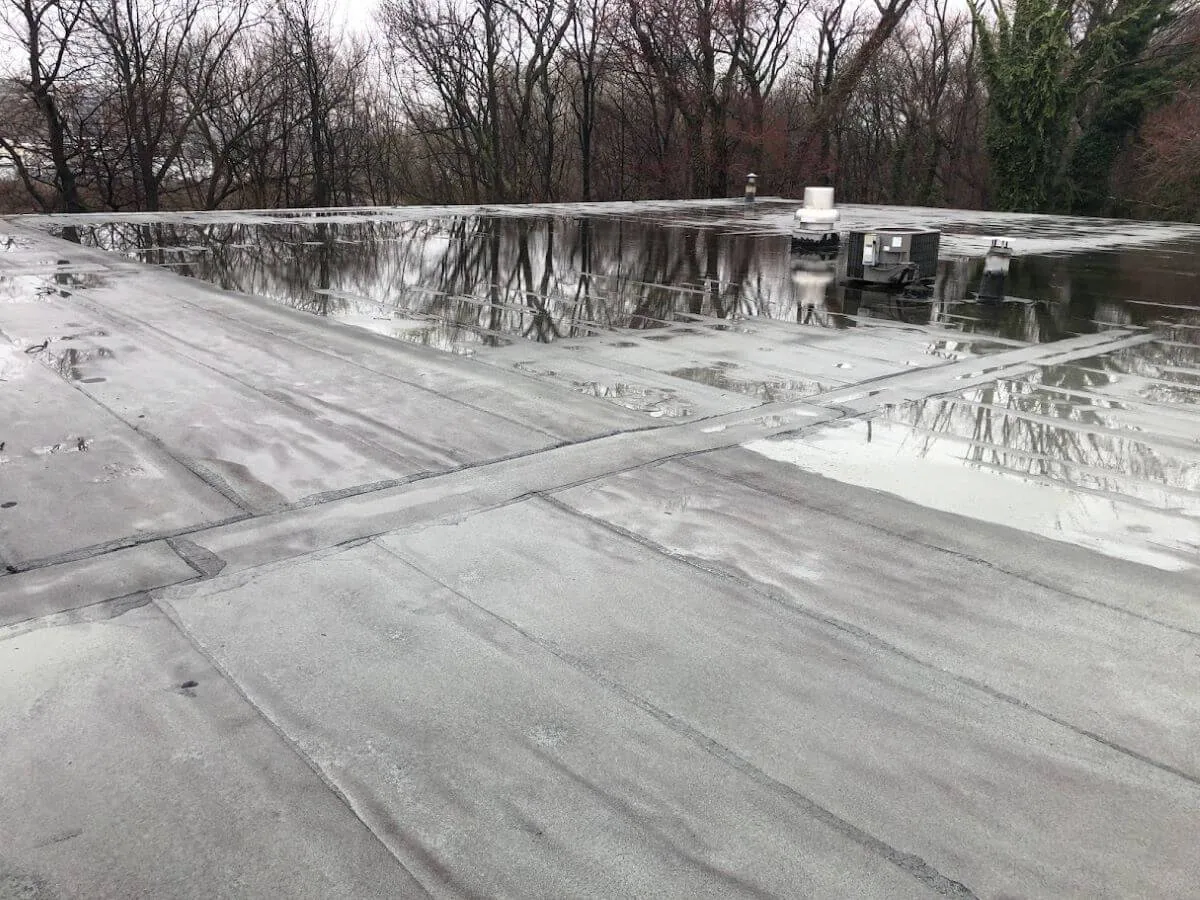
With commercial roof repair, we also look for the cause. Ponding water, foot traffic, a vibrating unit or a poorly installed earlier repair can all make the same spot fail again. If the cause is something we can address, such as adding walk pads or a small cricket, we include it as an option.
We explain why the repair is the size it is. Owners are sometimes surprised that a small drip needs a several-foot repair, but patching only the visible hole often means calling us back a few months later.
Every repair is tied to a location, a photo and a clear description, so you can see what you are paying for.
Check what has to stay in place
Many Parker buildings have been patched more than once. Before we tie into an old patch, we check whether it is sound and compatible with the new material. On a TPO roof, an old patch may be TPO, or it may be a peel-and-stick product, an asphalt mastic or a coating. TPO only welds to clean TPO.
If the old patch is incompatible or failing, we cut it out and repair the area properly. If it is sound TPO, we clean it and weld to it, testing a small area first. Older TPO can be stiff and dirty, so cleaning matters.
We also check the membrane around the repair. If it is brittle, cracked or badly worn, a patch may not hold, and we will tell you.
The same goes for the insulation underneath. If it is wet, it comes out and new board goes in before the membrane is closed.
Know when to look at the whole roof
Sometimes a leak is a sign of a bigger problem. If we find the same failure in several places, widespread wet insulation or a membrane that is wearing out across the whole roof, a local repair will only buy a short time.
In that case, we recommend a roof condition report. It looks at the whole roof: membrane, seams, flashing, drainage and insulation. It gives you a realistic idea of how much life the roof has left and what your options are, from targeted repairs to coating, recover or replacement.
We are careful not to stretch a single repair into a judgment about the whole roof. One bad seam does not mean the roof is shot. But a pattern of failures is worth paying attention to, and a condition report is a modest cost compared with replacing a roof sooner than necessary.
If you do not need that now, we fix the leak and note what we saw so you can revisit it later.
Plan around the building's schedule
Small commercial buildings often have just a few people inside, but they still need the building to work. On an office building, we ask about business hours, parking and anyone in the building who needs to know we are on the roof.
For churches and community buildings, we ask about services, events and weddings. Nobody wants a roofing crew running a torch during a funeral. We schedule around those dates.
We also ask about roof access. Some smaller buildings have no roof hatch, so we need a ladder spot that is safe and out of the way. We agree on where materials go and how debris is removed.
If the repair might produce odors, we check where the air intakes are and coordinate with whoever handles your HVAC.
We also make sure the work area is cleaned up each day, with no loose fasteners or scraps left where people walk or park.
Keep the decision on file
When the repair is done, we send a short report: the problem, what we found, what we fixed and photos before and after. If we replaced wet insulation or cut out an old patch, those photos are included.
The report also notes anything else we saw. If we think the roof should have a full condition review in the next year or two, we say so and explain why.
This record is useful for small building owners who may not have anyone tracking roof history. Keep it with your property files. If you sell the building or call a roofer again in a few years, it shows exactly what was done.
If one of our repairs ever lets water in again, call and we will come out to see what went wrong.
Commercial Roofing Questions
What makes a local roof repair worth doing?
It fixes the problem and the weak material around it, and it addresses the cause when possible. Patching only the visible hole often means another call a few months later.
Can an old patch stay in the repair area?
Only if it is sound and compatible with the new material. On TPO, incompatible patches like asphalt mastic or peel-and-stick are cut out before welding.
When should the insulation under a repair be checked?
Whenever there has been an active leak. Wet insulation is replaced before the new membrane goes down.
When is a whole-roof review worth it?
When we see the same failure in several places, widespread wet insulation or a membrane wearing out across the roof. A condition report gives you a clear picture of your options.
What will I get when the repair is done?
A short report with photos of the problem, any hidden damage, the finished repair and notes on other areas worth watching.
Get an honest repair answer for your Parker building
Call or write with the building and the issue. We will inspect it, recommend a repair that makes sense and tell you plainly if the roof needs more.
Request a Roof Assessment in Plano
Tell us about the building, the roof and what you are seeing. Send a request or call 555-555-5555.