
Commercial Roof Repair in Fairview
Home / Service Areas / Fairview
In Fairview, a lot of our roof calls start with a ceiling tile. A stain shows up in a medical suite, a shop or an office, and the manager wants to know two things: where is the water coming from, and how much will it cost to stop it. Those are fair questions, and the honest answer usually starts with an inspection, because the stain is rarely right under the hole.
We work across Fairview and nearby Allen and Lucas, on low-slope roofs over retail centers, offices and small medical buildings. We find the source, fix it with materials that match the roof and leave you a short report that will make the next leak easier to deal with.
Trace the leak from inside to the roof
Before we climb up, we ask your team a few simple questions. When did the stain appear? Does it get worse after heavy rain, after wind-driven rain, or when the air conditioning runs? Is there equipment or a skylight nearby? Photos of the ceiling and any wet floor help us line up the interior spot with the roof above.
On the roof, we start over the stain and work outward. Water can run along a deck flute, a pipe or a beam before it drops, so we check seams, curbs, penetrations, drains and wall flashing in the area. Sometimes the culprit is not the roof at all: a condensate line, a clogged HVAC drain pan or a cracked parapet wall can look like a roof leak from below.
Once we find the likely entry point, we tie it to a specific commercial roof leak repair. If we cannot confirm the source on the first visit, we tell you what we ruled out and recommend a water test or a closer look rather than guess.
Fix the detail that failed
Most leaks come from details, not the open field of the roof. A curb flashing that has pulled loose, a pipe boot that has split, a seam that was never fully welded. We repair the specific detail and the membrane around it, not just smear sealant on the visible crack.
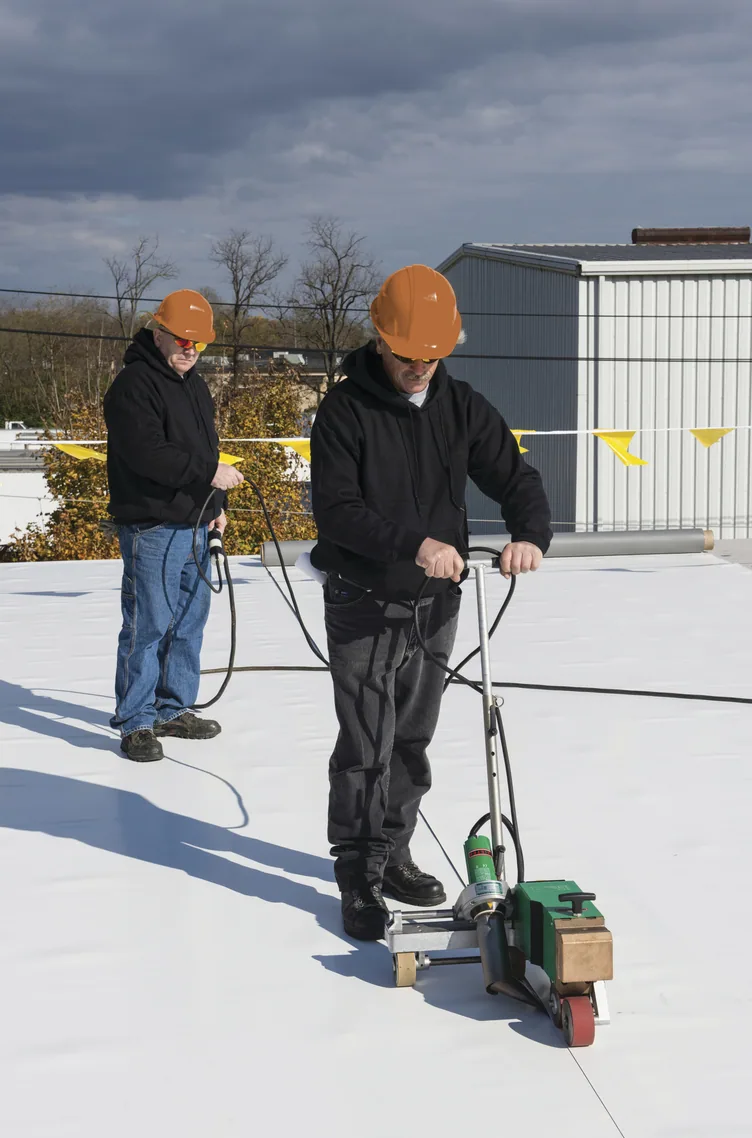
On a PVC roof, that usually means cleaning the existing sheet, cutting out damaged flashing and hot-air welding new PVC flashing to it. We probe every new weld once it cools. If the existing PVC is brittle or contaminated, we test a small weld first to make sure the new material will bond.
We also look at what caused the failure. If a unit vibrates and tears the flashing, the repair should include better support or more slack. If ponding water sits against a seam, we may recommend a drain or cricket. Fixing the cause keeps you from paying for the same leak twice.
Check what is under the wet spot
A wet ceiling often means wet insulation above it. Wet insulation loses much of its insulating value, can stay damp for a long time and eventually damages the deck. Before we close up the repair, we cut a small test opening and check whether the insulation is dry.
If it is wet, we remove the soaked boards and replace them before the new membrane goes down. That adds cost, and we show you photos before doing it. If wet areas look bigger than the repair, a roof condition report or moisture survey can map how far the damage extends so you can decide between a larger repair and a planned replacement.
We also check the deck where we can see it. Rusted metal or soft wood near a long-running leak needs to be dealt with now, not covered up. Everything we find goes into the report with its location.
Work around tenants and patients
Fairview has a good number of medical office buildings, and they bring their own rules. Some suites cannot have dust, odors or loud work during patient hours. Some have sensitive equipment directly below the roof. We ask about those things before scheduling and plan quieter tasks during open hours and noisier ones early or late.
We also ask who needs to know when we are on the roof, and which interior spaces we might need to enter to check the leak from below. Tenants should be warned before a crew walks through their suite, and ceiling tiles should be moved only with permission.
Odors are worth mentioning. Some primers and adhesives have a smell that can be pulled into the building through rooftop air intakes. We note intake locations and, where needed, coordinate with your HVAC contractor to shut down or shield them while we work.
A report you can use next time
When the repair is done, we send you a short report. It shows the interior location you reported, the roof location we traced it to, photos of the damage, any wet insulation we replaced and the finished repair.
That report is more useful than it sounds. If another stain shows up next year, you can see straight away whether it is the same area or a new problem. If you sell or refinance, an inspector or lender will want to know what was done and when.
We also list nearby issues we saw but did not fix, such as an aging seam, a cracked sealant pocket or a drain that holds water. Those are notes for your maintenance plan, not upsells.
If the leak turned out to be from something other than the roof, such as an HVAC drain or a wall crack, we say so clearly. That way the right contractor gets the call and you are not paying a roofer for a plumbing problem.
Commercial Roofing Questions
What information helps you track down a leak?
When the stain appeared, what weather makes it worse, photos of the ceiling and floor, and whether there is equipment, a skylight or a wall nearby. That helps us line up the interior spot with the roof above.
Does the stain show exactly where the roof is leaking?
Usually not. Water can travel along the deck or a pipe before it drips. We start above the stain and check the details around it until we find the actual entry point.
How do you choose repair materials?
We match the existing roof. PVC gets welded PVC flashing, EPDM gets compatible primers and tape, and so on. If the existing sheet is aged or contaminated, we test a small section first.
What can change the price once the roof is opened?
Wet insulation, rotted wood or rusted deck under the repair. We photograph it, explain what needs replacing and give you the added cost before we close the roof.
What will I get after the repair?
A short report with the interior location, the roof location we fixed, photos of the damage and the finished repair, plus notes on any other areas that may need attention.
Find the source of your Fairview leak
Tell us where the stain is and when it appears. We will trace it on the roof, fix the detail that failed and send you a clear report with photos.


Request a Roof Assessment in Plano
Tell us about the building, the roof and what you are seeing. Send a request or call 555-555-5555.